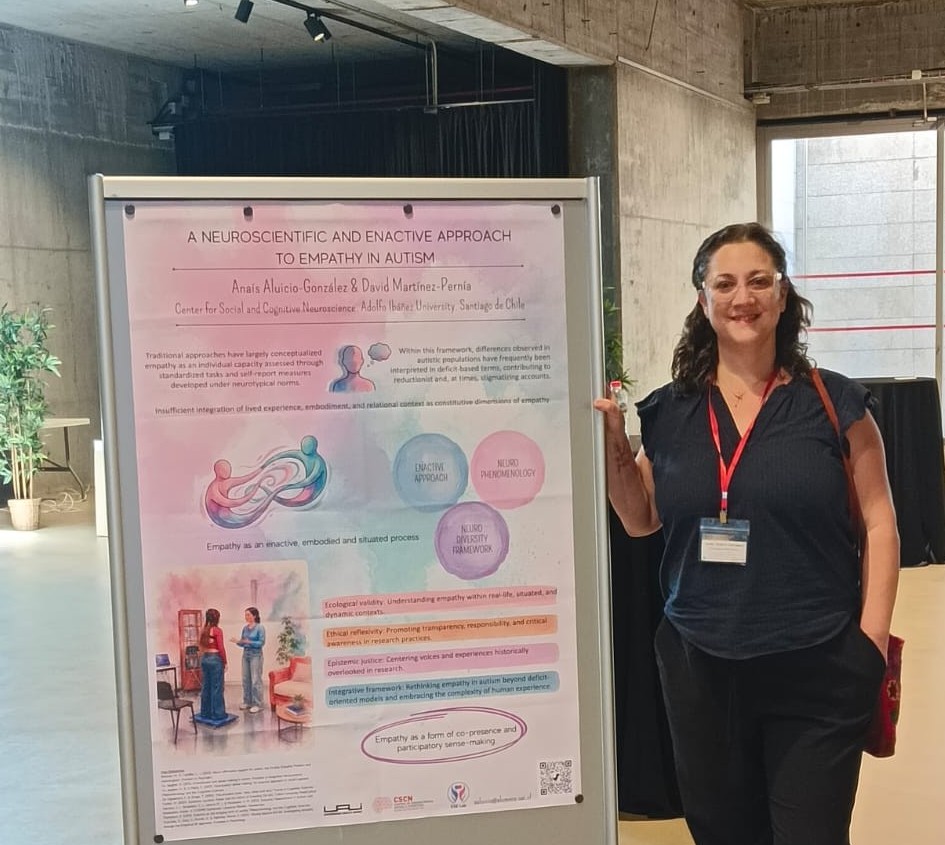
I am currently working on two closely related research projects focused on empathy from an embodied and experiential perspective.
First, I am part of David Martínez-Pernía’s FONDECYT project, “Enactive Empathy: A Multimodal Study of the Relevance of the Body, Experience, and Temporality in Emotional Connection with Others.” This project investigates empathy as a dynamic, embodied process, examining how emotional connection with others unfolds across bodily, neurophysiological, experiential, and temporal dimensions. Using a multimodal neurophenomenological approach, the study combines EEG, eye-tracking, cardiac and respiratory activity, electrodermal responses, and first-person experiential interviews while participants engage with emotionally meaningful audiovisual material. A central aim is to understand empathy beyond isolated cognitive mechanisms by examining the reciprocal relationships between lived experience, bodily regulation, attention, and their temporal dynamics.
Second, I am developing my doctoral research on empathy in autistic people through a neurophenomenological framework. My research seeks to understand autistic empathy by bringing first-person experience into dialogue with physiological, behavioural, and embodied measures, rather than approaching empathy primarily through externally defined behavioural or cognitive indicators. The project adopts an explicitly neuroaffirmative orientation and a participatory research design, recognising autistic people as epistemic agents whose perspectives should contribute not only as research data but also to the conceptualisation, methodological development, and interpretation of the research. More broadly, I am interested in exploring how neurophenomenology can contribute to a more embodied, situated, and neuroaffirmative understanding of autistic empathy.